
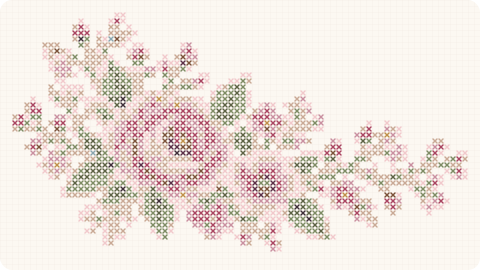
Parking and cross-country are two ways of organizing thread movement in counted cross stitch, especially on large or full-coverage patterns. Neither changes the basic cross stitch itself. The difference is what you do after finishing a small group of stitches in one color. With cross-country stitching, you normally continue that color to another nearby area. With parking, you stop at a planned boundary and leave the thread ready at the next stitch where that color will be used.
What cross-country stitching means in practice
Cross-country stitching follows one color across an area before switching. You may complete every nearby symbol of that color within a page, a section or a distance you consider safe, then end the thread or move to the next color. This can feel intuitive because you are making visible progress with one color instead of managing several parked threads at once.
It works especially well when the pattern contains clear blocks of color. A sky, large background or geometric section with repeated symbols can often be stitched quickly this way. The main risk is counting long jumps. The farther you travel across blank or unfinished space, the easier it is to place a stitch one square off and then build more stitching from the wrong reference.
What the parking method changes
Parking keeps the work moving through the chart in a controlled sequence. You stitch a color inside a chosen row, column, block or diagonal section, then bring the thread to the front at the next symbol where that color will be needed and leave it there. When you reach that position later, the waiting thread tells you both which color is needed and where it resumes.
This is popular in dense full-coverage designs with many color changes because it reduces long counting jumps. Instead of chasing a symbol across an entire page, you progress through neighboring cells. The trade-off is thread management: several colors can be parked at the same time, so keeping them separated and labeled becomes part of the technique.
Which method handles confetti more comfortably
Confetti means isolated stitches or tiny groups of color scattered among many other shades. Cross-country can become frustrating when one symbol appears once, disappears for twenty squares and then returns. You either carry the thread a long way, end and restart it repeatedly, or make large counting jumps.
Parking can make confetti easier to track because each color waits near its next use. However, a chart with dozens of active colors can create a forest of loose threads. Some stitchers park only the most frequent confetti colors and use cross-country for larger blocks. A hybrid approach is often more practical than treating either method as a strict rule.
How each method affects counting errors
Cross-country relies heavily on reference points. If you count ten or twenty squares from one stitched area to another and make a mistake, the misplaced stitch can become the reference for later stitches. Gridding and marking progress on the chart reduce this risk, especially on patterns with large empty gaps or repeated symbols.
Parking keeps the working edge more compact, so you are usually counting short distances. That can make location easier to verify. It does not make mistakes impossible: parking a thread in the wrong hole can propagate the same error if you trust it without checking. Whatever method you use, compare regularly with grid lines, page coordinates or already confirmed stitches.
How the back and thread usage differ
Cross-country may create longer carries on the back if you move between separated groups without ending the thread. Long dark carries can show through pale fabric, so distance and contrast matter. Parking often produces shorter transitions because colors move through adjacent sections, but parked threads can tangle on the front if they are not kept organized.
Neither method automatically uses dramatically less floss. Thread consumption depends more on how far you carry, how often you start and finish, your tension and the pattern itself. If saving thread is important, avoid extreme carries and repeated wasteful starts rather than assuming one entire method is always more economical.
How to choose for your own pattern
Use cross-country when the chart has recognizable color blocks, when you prefer working with one thread at a time, or when the counting distances are easy to verify. Use parking when a full-coverage section contains heavy confetti, many active colors or a working edge that you want to advance in a controlled order.
You can switch methods within the same project. A large solid background might be faster cross-country, while a detailed face or textured area is easier with parking. The useful question is not which technique is universally better, but which one reduces counting effort and thread chaos in the section currently in front of you. Choose the structure that makes the chart easier to follow.