
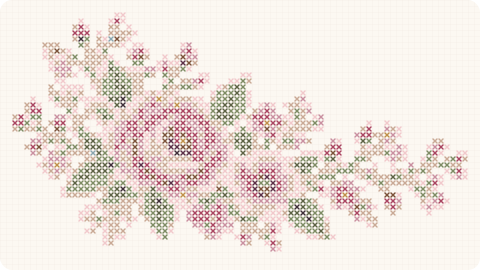
The question “how long does cross stitch take?” has no single answer because two patterns with the same outside dimensions can require completely different amounts of work. A solid color block moves much faster than a portrait filled with constant changes and isolated stitches.
You can still make a useful estimate by combining stitch count, your own speed and the complexity of the chart.
Start by estimating the number of completed crosses
Outside dimensions are not enough. A 100 × 100 chart contains 10,000 possible positions, but may use only a fraction of them when the background remains open.
Some design programs provide the total number of stitches, making the estimate much easier.
If you do not have that figure, look at density. An open motif can take a fraction of the time required by a full-coverage chart using the same grid.
Remember backstitch, French knots and other techniques. They usually represent fewer marks than the crosses but add a separate finishing stage.
Measure your own stitching speed rather than using a universal number
Stitch for one normal hour without trying to race and estimate how many full crosses you complete.
Repeat the test during two different sessions if you want a more realistic average. Speed changes with fatigue, chart complexity and color changes.
Divide the estimated stitch count by your approximate hourly rate. The result gives stitching hours, not calendar days.
If you complete 300 crosses an hour, 6,000 crosses would theoretically take about 20 hours under similar conditions. Heavy confetti may reduce that rate significantly.
Add time for everything that is not a cross
Preparing floss, changing colors, marking progress and correcting mistakes are part of the project too.
On multicolor charts, those minutes accumulate. Two designs containing 5,000 crosses can feel completely different when one uses four shades and another uses thirty.
Finishing matters as well. Washing, drying, pressing and framing may add another full session.
If the project is a gift with a deadline, leave room for days when you simply will not stitch.
Turn hours into a realistic calendar
An estimate of 20 hours does not automatically mean a three-day project. If you stitch for one hour on three evenings each week, it may last close to two months.
Plan around your actual routine rather than the amount of free time you wish you had.
For large projects, divide the target by weeks or chart pages. One huge number of hours may be less useful than knowing what you want to complete every seven days.
You can also alternate with small designs to maintain motivation without abandoning the main piece.
The purpose of an estimate is not predicting the exact minute of completion. It helps compare projects, plan gifts and decide whether the scale fits the time available now.
Do not reject a pattern simply because the estimate looks long. Some stitchers enjoy having one piece that stays with them for months. The calculation is a planning tool, not a competition to finish as quickly as possible.
We also want our product pages to help you estimate the real commitment through concrete details: size, coverage, color count and techniques. We cannot tell you exactly how many hours you will need, but we can give enough information to distinguish a weekend project from a piece that may stay with you for months.
Your speed also changes within the same pattern. A large solid block may move very quickly while a small area full of color changes takes much longer. That is why a useful estimate combines stitch count with color density and techniques rather than relying only on the outside dimensions of the design.
A practical way to measure your own pace is to stitch for one normal hour without deliberately trying to go faster, then count roughly how many full crosses you completed. Repeat the test over two or three sessions and use an average. That number will be far more useful than a universal rate.
Then add time for preparation, thread changes, backstitch, corrections and finishing. On a limited-color chart that may be a small proportion; on a confetti-heavy design it can account for a significant part of the project.
If the piece is a gift, turn the hours into weeks based on your real routine. Twenty hours might mean four concentrated evenings for one person and two months for another. Planning with a calendar prevents a meaningful deadline from becoming pressure.
You can also use the estimate to choose between two patterns in our collection. The goal is not to tell you which project is “better,” but to give you enough information to decide which one fits the time you have now.
And remember that a long project is not wasted time when you enjoy the process. Sometimes you specifically want a piece that stays with you for months. The estimate is there to support an informed choice, not turn stitching into a race.