
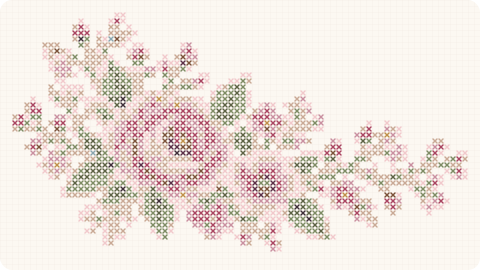
Hand-dyed floss can add color movement, depth and small irregularities that do not appear in standard solid cotton. That variation is part of its appeal, but it also makes the result less predictable and requires more attention to stitch direction and how much thread is available.
You do not need a special chart to use it. A simple monochrome design can change completely when the color moves along the strand.
What makes hand-dyed floss different?
The main difference is that color can vary within one skein or between dye lots.
Some transitions are soft and tonal; others move between clearly different colors.
Even two skeins sold under the same name may not be identical.
For a large project, it is sensible to buy enough thread at the beginning.
How to plan the direction of color
Stitch order changes how the variation appears.
Completing each cross before moving to the next keeps color changes more localized.
Working long rows can create more obvious bands.
Make a sample to decide whether you want controlled transitions or a more irregular effect.
Combining hand-dyed and solid colors
One hand-dyed floss can become the focal color while solids provide support.
You can also reserve it for one word, flower or specific motif.
Avoid using too many variable threads at once when the chart is already visually complex.
One specialty color often stands out more when the rest of the palette stays quiet.
Handling differences between skeins
If a second skein is required, compare it physically with the first.
When the difference is visible, alternating short sections can soften the transition.
In a broad background or color block, a sudden dye-lot change may form a line.
In small scattered motifs, the difference may be almost invisible.
Washing and color stability
Artisan threads may have different care instructions from standard cotton.
Always check the maker’s guidance before washing the finished piece.
If color transfer is a concern, test a short piece before using it on pale fabric.
Do not assume every hand-dyed thread behaves in the same way.
Patterns that make the best use of hand-dyed floss
Monochrome charts, lettering, borders, leaves, geometry and silhouettes are excellent candidates.
The variation can sometimes replace several solid shades by providing its own depth.
In realistic portraits, unpredictable transitions may be harder to control.
In abstract or modern designs, that unpredictability can become part of the appeal.
Hand-dyed floss works best when you accept that it will not create two perfectly identical pieces. Variation is part of the material and can turn a simple chart into something highly personal when quantity, stitch route and care are planned from the beginning.
If the project will become a kit or finished sample, record the maker, color name and dye lot when available. That information makes it easier to reproduce the palette or explain small differences between later versions.
Hand-dyed floss is intentionally less uniform than standard solid cotton, which means two skeins with the same color name may still vary. Dye lot, base fiber and the way the skein was dyed can affect the final sequence. If a project will require more than one skein, obtaining enough from the same batch where possible reduces abrupt changes in a large continuous area.
Stitch order matters because the color movement is part of the effect. Completing each cross before moving on often keeps transitions more localized, while stitching one leg across a row and returning can spread the sequence differently. There is no universal best method. A small sample should be used to decide whether the design needs smooth progression, mottling or deliberately irregular variation.
Care instructions deserve attention before stitching. Some hand-dyed fibers may have different washing recommendations from standard colorfast cotton. The maker’s guidance should take priority, especially for strong reds, blues or other saturated colors. If the final piece must be washable, test a scrap or short thread sample before committing the entire project to a care routine.
Our PDFs should not treat a hand-dyed color as though it were an exact digital swatch. If a design relies on a specific specialty floss, we should identify maker and color name and explain that natural variation is expected. The preview represents the intended mood rather than guaranteeing that every stitched section will have the same transitions.
These fibers work especially well in patterns that give them room to become visible: monochrome silhouettes, borders, lettering, leaves and simple motifs. In a chart already containing dozens of colors, subtle hand-dyed variation may disappear. Designing the grid around the fiber can produce a more intentional result than replacing one solid color at the last minute.