
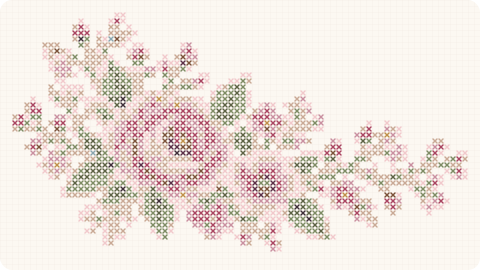
Cross stitch and embroidery are often grouped together because both use needle and thread, but they organize stitches in very different ways. Cross stitch is a counted technique: the design is mapped to a regular grid and most of the image is built from repeated X-shaped stitches. Free or surface embroidery can place many different stitches wherever the transferred design requires them.
That difference changes the fabric, the way a pattern is read, the skills that feel difficult and the finished texture. Neither technique is inherently better. The useful question is which structure suits the result you want and the way you enjoy working.
The structural difference: grid versus free placement
In counted cross stitch, each chart symbol corresponds to a specific position on the fabric. On Aida, the squares and holes make that grid very visible. On linen or evenweave, the same logic is created by counting fabric threads. Once the starting point is correct, the chart acts like a coordinate map.
Surface embroidery is not normally restricted to one repeated unit. A stem stitch can follow a curve, satin stitch can fill a petal, French knots can add dots and long-and-short stitches can create blended shading. The stitcher follows a transferred outline or works from placement guidance rather than matching every mark to one identical square.
This is why cross stitch naturally produces a geometric or pixel-like image, while embroidery can produce flowing lines, raised texture and more drawing-like surfaces.
Fabrics, needles and thread
Cross stitch usually works best on a countable ground such as Aida, evenweave or linen. A blunt tapestry needle is common because it should pass through existing holes or between fabric threads rather than pierce them. Stranded cotton is popular because the number of strands can be adjusted for the fabric count and desired coverage.
Surface embroidery can be worked on a much wider range of stable woven fabrics. Because the needle often needs to enter at an exact point rather than an existing hole, sharper embroidery or crewel needles are common. Thread choice can include stranded cotton, pearl cotton, wool, silk and many specialty fibers depending on the stitch and texture.
The materials overlap, but they are not automatically interchangeable. A needle and strand count that feel ideal on 14-count Aida may not be the right combination for a dense satin-stitch area on cotton fabric.
How the learning curve differs
Cross stitch has a small basic stitch vocabulary, so the first X is easy to learn. The challenge grows through accurate counting, keeping the top leg of the crosses consistent, managing a large chart, changing colors and handling additions such as backstitch or fractional stitches.
Embroidery distributes the challenge differently. The stitcher may need to learn several stitch families, control curves, judge spacing and decide how densely to fill an area. Two people following the same embroidery design can produce visibly different texture because hand placement is part of the result.
For a beginner who likes precise instructions and knowing exactly where each stitch belongs, cross stitch can feel reassuring. Someone who enjoys drawing, variation and choosing how a line should curve may prefer embroidery. A small sample of each reveals that preference more reliably than any abstract difficulty ranking.
What changes in the finished look
Cross stitch embraces the square grid. It is particularly effective for geometric designs, lettering, repeat patterns, stylized illustrations and images deliberately translated into pixels. Even highly realistic cross stitch still reveals its grid when viewed closely.
Embroidery can create smoother curves and more varied surfaces because stitch length and direction are flexible. Satin areas can reflect light differently from knots or chain stitch, and long-and-short shading can blend without being constrained to square blocks.
That does not mean cross stitch should try to imitate every embroidery effect. A strong cross-stitch design uses the grid as part of its visual language. Trying to hide it with excessive colors or outlines can make the chart more complicated without making the finished piece more convincing.
Which technique suits which project
Choose cross stitch when you want a highly repeatable result from a chart, enjoy counting and want to calculate finished size directly from stitch dimensions and fabric count. It also works especially well for downloadable PDF patterns because the instructions can map each symbol to an exact location.
Choose surface embroidery when curves, varied stitch texture or freer placement are central to the idea. Floral line work, textured lettering and painterly fills often benefit from techniques that are not restricted to a square grid.
Finishing can overlap: both can be framed, sewn into accessories or mounted in hoops. Raised embroidery may need extra care when pressing, while cross stitch needs the counted fabric to remain square during washing and mounting.
What a premium cross-stitch PDF should make clear
A good cross-stitch PDF should remove the decisions that belong to the designer while leaving the enjoyable stitching to the customer. It should state stitch width and height, finished measurements at the recommended fabric counts, fabric type, strand count, thread colors, stitch types and difficulty based on the actual techniques involved.
The chart needs distinct symbols, clear ten-stitch references and readable page transitions. Backstitch, fractional stitches or specialty fibers should be explained explicitly. The preview, grid and legend should all describe the same final design.
If MAKE later expands into other forms of embroidery, each product should name the technique precisely rather than using “embroidery” and “cross stitch” as interchangeable marketing terms. Clear terminology helps the customer buy the right fabric and tools and understand exactly what kind of making experience the pattern is designed to provide.