
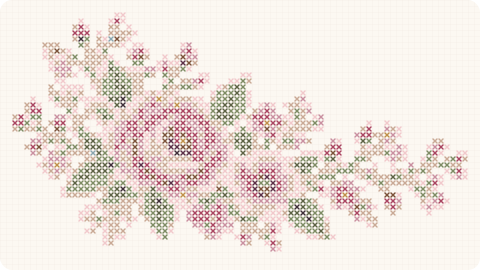
A cross stitch sampler is a composition built from related elements rather than one continuous picture. Alphabets, numbers, borders, dates, initials, small motifs and decorative dividers can all appear in the same piece. Historically, samplers were used to practise and record needlework skills; today they can be historical reproductions, family keepsakes or completely modern graphic designs.
That broad definition is useful because it explains why two samplers can look nothing alike. One may use muted thread on linen with houses and birds, while another uses bright geometric icons and contemporary lettering. What connects them is structure: the eye moves through a collection of smaller parts that have been organized into one larger whole.
What actually makes a design a sampler
There is no single compulsory ingredient. A sampler does not need an alphabet, and it does not have to imitate an antique. In practice, the strongest examples contain several independent motifs linked by spacing, palette, scale, borders or typography.
This modular construction also changes the stitching experience. You can complete one small section at a time and see regular progress even when the finished piece is large. Stitchers who dislike long areas of full coverage often enjoy the variety of moving between letters, flowers, symbols and borders.
Before choosing a chart, look at the composition as a whole. Individual motifs may be attractive, but they should not feel like unrelated clip art placed inside the same rectangle. Repetition and visual hierarchy are what turn a collection into a coherent sampler.
Traditional, commemorative and modern samplers
Traditional samplers often feature alphabets, houses, birds, floral bands, crowns, trees and geometric borders. Historical reproductions may preserve original spelling, unusual spacing and even mistakes made by the original stitcher. Other editions deliberately regularize colors or lettering, so it is worth reading what the designer has changed.
Commemorative samplers are built around an event or identity: a birth, wedding, anniversary, family name or home. Here, personalization is not a small extra. The size of the name, date and central text affects the spacing of the entire composition.
Modern samplers can use the same modular logic without looking historical at all. Food icons, abstract shapes, science motifs, plants, pop-inspired objects or a graphic alphabet can all work if the spacing and visual language are consistent.
How to judge sampler difficulty
Open background does not automatically mean easy. A sampler may use dozens of small color changes, fractional stitches, specialty stitches, backstitch or very fine lettering while leaving most of the fabric unstitched.
For a first sampler, look for full crosses, a limited palette and clearly separated sections. Finishing one motif in a sitting makes it easier to keep your place and gives a stronger sense of progress than working across a wide field of scattered stitches.
Check total dimensions as well as individual motifs. A chart can be made entirely of easy elements and still take months because the overall rectangle is large. The pattern should give stitch dimensions so you can estimate both physical size and workload.
Fabric count changes more than the frame size
Samplers often expose a lot of fabric, which makes the background an active part of the design. Linen and evenweave suit fine lettering and historical styles, while Aida is completely valid and easier to count. The best choice is the one that supports the look and the stitcher’s confidence.
A higher count makes the finished sampler smaller without changing the chart, but it also makes every letter and narrow border physically smaller. A 10-stitch-high alphabet that reads comfortably on 14 count may feel delicate on 20 count. Check the smallest text before deciding to reduce the whole piece.
Leave a generous margin for finishing. Large samplers are often framed, and cutting fabric too close to the outer border can make mounting difficult after many weeks of work. A premium pattern should give finished measurements at several common counts and suggest an appropriate fabric cut.
Historical reproductions, originality and copyright
Very old samplers may be in the public domain, but a modern chart, photograph, transcription, color conversion or edited reproduction can still contain protected creative work. If you want to stitch a reproduction, use the pattern according to its license rather than assuming that the age of the original object makes every modern edition free to copy.
For original commercial designs, the better route is to study sampler structure rather than copy a specific modern chart. Repetition, alphabets, borders and modular composition are general ideas; the exact motif drawings, arrangement and artwork should be your own.
That opens interesting possibilities for our own collections. A sampler can carry a recognizable MAKE visual language through original icon sets, contemporary lettering and coordinated color systems without pretending to be an antique reproduction.
What a premium sampler PDF should include
A full overview page is essential because the stitcher needs to understand the entire composition before moving through enlarged chart pages. Page breaks, overlap rows and long borders should have clear reference marks so a motif is not accidentally shifted at a join.
The PDF should list stitch dimensions, finished sizes at recommended counts, fabric suggestion, thread colors, strand counts and all specialty stitches. If personalization is included, the exact name or date should be shown in the final grid, and any optional alphabet should be clearly separated from the stitch-ready personalized version.
Preview, chart and legend should describe the same design exactly. A sampler may contain many small elements, but the documentation should reduce complexity rather than add to it. The strongest patterns give visual variety while remaining predictable to navigate, which is precisely what makes a large sampler satisfying instead of exhausting.