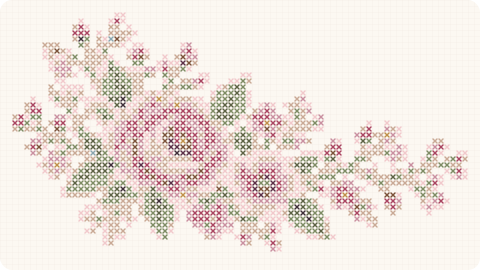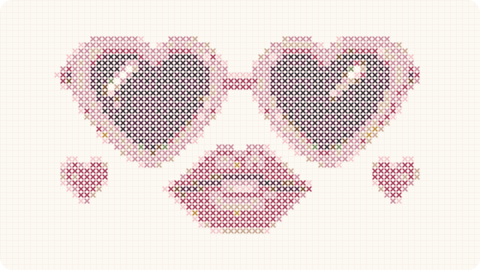
Cross stitching on clothing takes the design beyond a hoop: T-shirts, denim jackets, pockets, tote bags and hats can all become surfaces for stitched motifs. Because these fabrics do not contain a visible grid, waste canvas or water-soluble canvas is normally used as a temporary guide.
The process requires more preparation than stitching on Aida, but the crosses themselves remain the same.
Choose a stable garment
Woven, relatively firm fabrics are easier than very stretchy knits.
Denim, canvas and stable cotton provide comfortable bases.
On jersey T-shirts, use stabilizer so the fabric does not stretch while you work.
Wash the garment before stitching when shrinkage is possible.
Add a temporary grid
Waste canvas is basted onto the garment and its threads are removed afterward.
Water-soluble canvas also provides a grid and is removed with water according to its instructions.
Center and secure the guide carefully so it cannot shift.
Check orientation and physical size before making the first stitch.
Tension and stabilization
Do not pull with the same force you might use on stiff Aida; the garment can distort.
A hoop can help provided it does not stretch the base fabric excessively.
On stretchy material, backing stabilizer keeps the working surface controlled.
Make a few test crosses to check coverage and tension.
How to choose the design
Small graphic motifs are easiest to integrate into clothing.
Pockets, chest areas, sleeves and the upper back are common placements.
Avoid making a very stiff stitched patch across an area that needs to bend constantly.
Remember that the reverse may touch skin or inner clothing; flat finishes are more comfortable.
Washing and durability
Use thread suitable for a garment that will be washed.
Secure ends carefully and avoid loose tails.
Use a gentle washing routine and avoid unnecessary high temperatures.
For delicate stitching, washing the garment inside out can reduce abrasion.
Cross stitching clothing is essentially the process of adding a temporary grid to fabric that does not already have one. Once the guide is secure and the garment stabilized, ordinary patterns can become wearable, highly personal pieces.
For a first attempt, try a tote bag or denim pocket before a stretchy T-shirt. A stable surface lets you learn tension and canvas removal without adding the extra challenge of fabric stretch.
Cross stitching on clothing changes the kind of product we can offer: the pattern does not end as wall art but becomes garment customization. That opens possibilities for denim, pockets, jackets, tote bags and other stable fabrics.
For designs intended for clothing, size needs to be planned around the real placement area. A motif that works in a wall hoop may be far too large on a pocket or sit awkwardly once the garment moves.
The product page should state physical dimensions, recommended temporary canvas type and whether the motif has been tested on a stable surface. It should also explain when stretchy fabric makes the project harder and requires additional stabilization.
Compact, limited-color patterns are especially useful because they tend to behave better through wear and washing: fewer long carries, fewer fragile areas and a back that is easier to protect.
Durability matters too. Secure finishes, moderate tension and washing care are more important on clothing than framed work because the embroidery will flex and be handled repeatedly.
A clothing collection can be organized by placement: pocket, chest, sleeve, back or tote. That lets customers choose by real dimensions instead of guessing whether the pattern will fit.
Before we sell a design as “for clothing,” we want it to be genuinely usable rather than simply shown in an attractive mockup. Grid, temporary canvas count, finished size and garment position need to relate clearly to one another.
We can also design collections intended to repeat across different garments: small compatible icons for pockets, sleeves or tote bags. That lets customers buy one set and use it several times without learning a completely different system for every motif.
On dark garments, temporary canvas and floss color need especially careful testing. A shade that stands out on white Aida may disappear completely on black denim, so previews should represent the real context rather than a generic white background.
If we offer personalization, an initial or small symbol may be more durable and versatile than a long name filled with detail. On clothing, a smaller stitched area usually behaves better through regular wear and washing.
Finishing guidance should also explain how to protect the reverse when the location will rub against skin or objects. Comfort is part of product quality when the embroidery is meant to be worn.