A small cross stitch pattern has one advantage that is easy to underestimate: you can experience the entire project before the initial excitement fades. Choosing floss, starting, watching the image appear, finishing and framing can all happen within days rather than weeks or months. That makes small patterns excellent for beginners, quick gifts or simply as a break between larger projects.
“Small” does not automatically mean simple, though. A compact chart can still contain a surprising amount of detail. If your goal is to finish quickly, look at color count, stitched density and thread changes as well as the dimensions.
What counts as a small cross stitch project
There is no official boundary, but a design around 30 to 70 stitches on each side usually fits comfortably into the idea of a small project. On 14-count Aida, a 56 × 56 stitch design creates an embroidered area of roughly 4 × 4 inches before adding fabric margins.
That scale fits small hoops and many standard frames. It also uses less fabric, which means offcuts from previous projects can become useful rather than sitting in a drawer. If you enjoy mini patterns, label those scraps with their fabric count so you know exactly what you have later.
Density matters. A fully stitched 60 × 60 square contains far more crosses than an open motif with the same outer dimensions. Two patterns with identical width and height can take very different amounts of time.
To estimate effort, inspect the preview. If much of the fabric remains unstitched and colors form clear blocks, it is likely to move quickly. If the entire grid is filled and the colors constantly alternate, it may take considerably longer.
Subjects that work especially well at a small scale
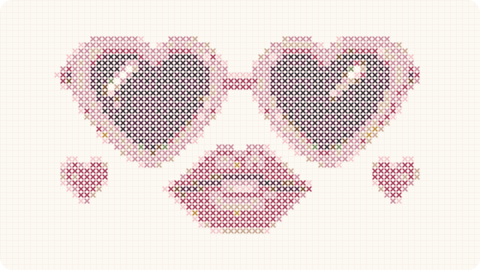
Everyday objects are ideal: a mug, camera, pair of glasses, piece of fruit, cocktail or candle. Their silhouettes are recognizable and they do not need hundreds of stitches to read clearly.
Animals work too when simplified. A cat head, bird, butterfly or stylized frog can keep plenty of personality with very little detail. Realism needs more space, but a graphic interpretation often benefits from being compact.
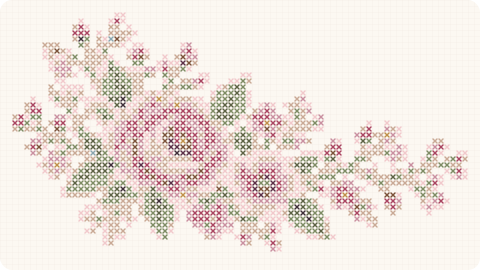
Single flowers, leaves and small vases are another reliable option. Several related pieces can become a series. The same is true of celestial symbols, food, letters and geometric icons.
If you like quote patterns, keep the wording short. One or two words are much easier to balance in a small format than a full sentence compressed into tiny lettering.
How to choose a pattern that will genuinely be quick to finish
Look for roughly four to ten colors, grouped color areas and few special stitches. A 50 × 50 chart with six flat colors can move very quickly. A 45 × 45 chart with thirty shades and heavy confetti may not.
Fabric count affects the feeling of speed too. Fourteen-count Aida has comfortable holes and slightly larger stitches. Moving to 18 count makes the physical piece smaller, but it does not reduce the number of crosses. If you stitch more slowly on a fine grid, the project may take just as long.
Organize the floss before you begin and keep the chart easy to access. On a short project, spending ten minutes in every session searching for the correct color has a disproportionate effect. A small organizer card with thread and symbols can make the process almost automatic.
What to do with mini cross stitch once it is finished
Not every project needs to become a large framed picture. Small hoops can hang directly on a wall; tiny frames can sit on shelves; you can also incorporate stitching into a card, ornament or small textile item if you know how to finish it securely.
Another option is grouping several pieces. Three designs around 3 to 5 inches with a shared palette can fill a wall more effectively than one large picture. You can complete them one at a time without taking on the entire commitment from the beginning.
For gifts, small projects are especially useful because they let you choose a personal subject without months of planning. An animal, drink, initial or symbol associated with someone can feel much more thoughtful than a last-minute generic object.
If you are learning, each mini project can also become a controlled experiment. Use 16-count Aida for one, change the palette on another and practice backstitch on the next. Finishing frequently does not mean staying at beginner level. It can be one of the most effective ways to try new things without turning every experiment into a huge investment of time.
Small patterns are also a good way to get to know a collection: you can try a visual style, palette or chart format without committing to weeks of work. That is why we see them as particularly useful first projects and thoughtful handmade gifts.