Cross stitch borders can work as decorative edges, dividers, frames for text or repeated elements on towels, linens, cards and small gifts. Although borders are strongly associated with traditional needlework, they can look very modern when the palette is reduced and the motif becomes geometric or simple.
The main advantage is modularity: one repeat can be extended as many times as needed to fit the final width.
Which types of borders work best?
Geometric borders are easiest to extend because the sequence is very clear.
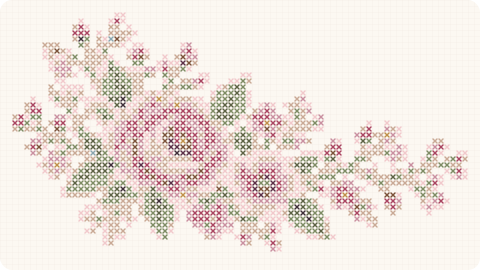
Flowers, leaves and small fruit create a botanical look.
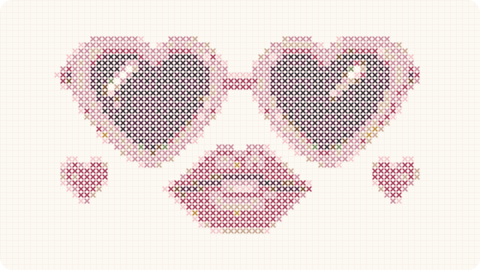
Stars, hearts and simple icons work well for children’s projects and gifts.
A border built from lines and blocks can feel highly contemporary.
How to adjust length without breaking the pattern
Identify the repeating unit before stitching.
Calculate how many complete repeats fit within the available width while leaving margin at both ends.
If space remains, center the border rather than stretching the motif unevenly.
At corners, some charts provide a special turning unit. If they do not, test the transition on graph paper first.
Using borders around lettering
Leave more breathing room than you think you need between text and the border.
A very detailed edge can compete with a short phrase.
If the wording is the main feature, use a simple one- or two-color repeat.
Check the full dimensions before starting so border and text are centered as one composition.
Modern and minimalist border ideas
Reduce the motif and leave open gaps inside the repeat.
Try one strong line of color rather than several stacked layers.
Use unexpected palettes: pink and red, green and lilac, black and cream.
You can also place a border on only one side of the design instead of surrounding it completely.
Projects where borders are especially useful
Towels and fabrics with a dedicated stitching band are a classic use.
Borders can frame names, dates or initials in small wall pieces.
On cards and ornaments, a short repeat adds structure without requiring a complex central motif.
Several different borders can even be combined into an abstract sampler.
The strength of a border lies in repetition, so it is worth checking one complete unit before stitching a long length. Once the module is correct, adapting the size becomes simple and the result can feel every bit as modern as a large geometric pattern.
Before using the final fabric, stitch one complete repeat on an offcut. That sample confirms real width, tension and color rhythm and can prevent discovering one mistake after it has already been repeated ten times.
Borders can become a very flexible product because one repeating unit can adapt to many widths. The chart needs to show exactly where the repeat begins and ends so resizing does not depend on guesswork.
For a modern collection, we prefer geometry, simplified leaves, dots, small flowers or abstract forms over very dense decoration. Leaving space around the motif keeps the result contemporary and reduces stitching time substantially.
We can also design borders as companions to alphabets and customizable patterns. A name with a coordinated frame can support wedding, baby or anniversary gifts without requiring an entirely new illustration.
The product page should state repeat width, border height in stitches and any special rule for corners. Those details turn the file into a useful design tool rather than simply a picture.
If several borders belong to one set, keeping height and palette compatible lets customers combine them within one project without the result feeling assembled from unrelated sources.
This kind of resource broadens the value of our library: we are not only selling closed images, but also carefully designed elements that let stitchers build their own compositions on a technically reliable base.
A successful border also needs a plan for corners. Repeating one horizontal unit does not guarantee that a ninety-degree turn will look clean. We can provide dedicated corner variants or explain which part of the repeat should be omitted so the frame closes without an awkward interruption.
That documentation adds real value in a digital product because the customer does not have to invent the solution while stitching. The more reusable a design resource becomes, the more important its rules are.
We can also sell themed sets —geometric, botanical, retro or minimalist— with compatible heights and repeat logic. Then the customer is buying a small design library rather than five unrelated charts, which supports both perceived value and repeat use.
For personalized products, that consistency also reduces production time: once one repeat and corner system has been tested, we can reuse it across names, dates and motifs without rebuilding the decorative frame from scratch for every order.