
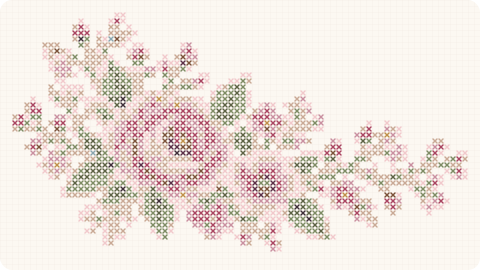
Wildflowers translate especially well to cross stitch because they do not require perfect symmetry or formal arrangement. One stem can lean, another can rise higher, and the composition still feels intentional. That freedom works for loose bouquets, narrow vertical pieces, scattered mini motifs and collections of individual species.
The challenge is keeping that natural rhythm on a square grid. If every stem has the same height and every bloom is evenly spaced, the finished chart can begin to look like a repeated border rather than a meadow.
Vertical bouquets adapt easily to many finished sizes
A narrow bouquet fits a small frame, the side of a monogram or a tall wall format. To enlarge it, you do not need to scale every flower. Adding secondary stems and small leaves can increase fullness while preserving the original focal bloom.
The composition usually benefits from one stronger flower and several supporting species. A poppy or large daisy can attract attention while grasses, lavender and tiny flowers fill the surrounding space.
Avoid making every stem emerge from exactly the same grid point. Shifting them by a few columns creates a looser structure and lets leaves overlap without forming a dense central block.
Mini wildflowers are useful for small projects and personalization
One lavender sprig, daisy or poppy can become a compact chart. These motifs work well for initials, cards, bookmarks and small gifts because they maintain a botanical identity without requiring a large project.
They also pair naturally with names and dates. A small flower on each side of a word can create a balanced personalized design with very few stitches.
At miniature scale, simplify petal count and shading. A recognizable silhouette matters more than reproducing every botanical detail.
Meadow palettes feel unified when greens are shared
A wildflower bouquet can include red, yellow, blue, purple and white without feeling chaotic if the stems use two or three shared greens. Those structural shades tie the entire composition together.
Slightly muted floral colors often feel more natural than maximum saturation. Terracotta, mustard, blue-gray, lavender and dusty pink create variety without competing equally for attention.
If you prefer a brighter style, increase saturation in one or two species and keep the rest calmer. This creates focus instead of turning the whole piece into a uniform rainbow.
Visible fabric is part of the botanical design
Wildflowers usually benefit from generous negative space. They do not need a fully stitched background or a box around them. White, cream or pale gray fabric acts as air between stems.
On colored Aida, check that pale flowers remain visible. A cream daisy can disappear on beige fabric. A soft outline or lighter petal shade may be enough to restore definition.
Fabric also changes the mood. Bright white feels crisp, oatmeal and light linen feel rustic, and pale blue can suggest sky without adding background stitches.
Difficulty comes from color changes more than flower shape
A delicate-looking chart can be surprisingly slow if every petal uses several colors. Check the thread key before choosing. Twenty shades scattered across small areas create far more work than ten colors used in continuous shapes.
Graphic bouquets with clear blocks are a good beginner option. Painterly charts with gradients suit stitchers who enjoy frequent changes and confetti.
Backstitch can create very fine stems, but it is not required. Full-cross-only designs can use stepped diagonals and small leaves to suggest slender lines.
Turn wildflowers into a collection without losing variety
A series can focus on individual species such as poppy, daisy, lavender, cornflower, chamomile and meadow grasses. Another approach is to make small seasonal bouquets that share the same dimensions and palette.
Repeating frame size creates cohesion. Six small botanical charts can become a gallery wall while remaining useful as individual gifts or projects.
For personalization, pair a flower with an initial or birth month. That connects wildflowers to birthdays, births and keepsakes without abandoning the loose meadow aesthetic.
The best wildflower chart does not need perfect botanical accuracy. It needs rhythm, open space and recognizable forms. If the composition still feels light and balanced in a thumbnail, it is likely to work beautifully once stitched.
If the pattern will become part of a botanical gallery wall, consider how it relates to neighboring pieces. Repeating flower height, frame width or the amount of negative space around each motif helps very different species feel like one collection. A consistent visual boundary can matter more than using the exact same colors.
Wildflowers are also useful for gifts because they can feel personal without requiring a specific occasion. A small bouquet can work for a birthday, housewarming, thank-you gift or simple decorative project. That flexibility gives a coordinated set more long-term use than a collection tied to one holiday.