
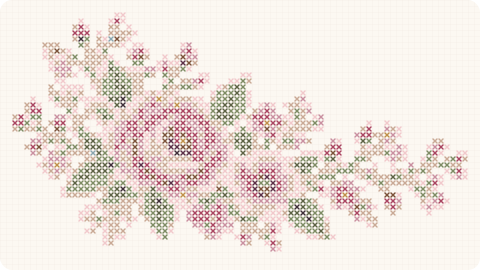
Cross stitch can technically be made with many fibers, including wool and acrylic yarn, but ordinary knitting yarn is much thicker than embroidery floss. Whether it works depends mostly on the fabric holes and the visual effect you want. Forcing bulky yarn through standard 14- or 18-count Aida can damage the weave, while coarse low-count canvas may handle it comfortably.
Compare thickness before choosing the fabric
Embroidery floss is made from fine strands that can be separated. Knitting yarn is usually a much larger construction even when labeled lightweight. A single yarn strand may equal several floss strands in bulk and cannot always be split cleanly.
Hold the yarn over the fabric hole without pulling it through. If the yarn already looks wider than the opening, repeatedly dragging it through will create abrasion and enlarged holes.
Low-count fabric is more suitable for bulky fibers
Large holes and larger stitch blocks give yarn space to pass. Very low-count Aida, needlepoint canvas, plastic canvas or other open grids are more natural partners for thick fiber than fine evenweave. The resulting crosses are larger and more textured.
Do not choose a huge needle solely to force yarn through a fabric that is too fine. If the needle has to stretch every hole dramatically, the material pairing is probably wrong.
Coverage changes quickly with thick yarn
One strand of yarn can completely fill a large stitch and may even obscure the fabric grid. That can be attractive for bold decorative pieces, but crowded intersections become bulky because several crosses share the same holes.
Stitch a small block before converting a whole chart. Check not only the front coverage but also how easily the needle passes through a corner already used by neighboring stitches.
A yarn substitution changes the scale and texture
If you move a chart from 14-count Aida to a much coarser grid so yarn can fit, the finished design becomes physically larger. A 100-stitch motif on 7-count material is roughly twice the width of the same 100 stitches on 14-count Aida.
The surface also becomes softer, fuzzier or more dimensional depending on the yarn. Fine details and tiny backstitch may no longer look proportional, so not every chart translates equally well.
Choose a needle designed for the fiber and grid
Use a blunt needle with an eye that accepts the yarn without scraping it. The needle should pass through the grid comfortably rather than forcing the opening wider. A smooth eye matters especially with loosely spun wool or acrylic that can split and fuzz.
Shorter lengths reduce wear. Thick yarn creates more friction against fabric edges than soft floss, so a long strand may look tired before it is finished.
Use yarn intentionally rather than as a direct replacement
If a PDF specifies two strands of embroidery floss on 14-count Aida, one strand of knitting yarn is not a predictable one-for-one substitute. You are changing both fiber and likely fabric count. Recalculate dimensions and test the combination first.
Yarn works best when the chunky texture is part of the plan: large ornaments, plastic canvas, bold typography, children’s craft grids or oversized wall pieces. For standard counted designs with fine detail, embroidery floss remains easier. The question is not whether yarn can form an X, but whether the grid has enough space for that X to remain neat.
Fiber composition changes finishing as well. Wool can felt or shrink with heat and agitation, while acrylic may react badly to high ironing temperatures. If you plan to wash the finished piece, test the yarn and fabric combination first and use the care requirements of the most sensitive material.
Color availability is another practical issue. A chart built around hundreds of embroidery-floss shades cannot be translated directly into a small yarn palette without changing the image. Yarn is therefore better for designs with fewer colors, bold shapes and clear outlines than for photo-style charts with subtle shading.
Backstitch may need adaptation too. Standard one-strand floss can look too thin beside chunky crosses, while full yarn may look too heavy. Test a finer coordinating yarn or embroidery thread to find a line weight that matches the new scale.
If you are adapting an existing chart, calculate fabric requirements again after choosing the coarser grid. Do not cut the same dimensions listed for 14-count Aida. Add normal finishing margins to the newly enlarged stitched size. The jump from floss to yarn can turn a modest motif into a surprisingly large textile.
Also consider weight. A dense field of wool or acrylic is heavier than cotton floss and may need firmer mounting when framed. Lightweight plastic canvas ornaments and wall hangings tolerate this naturally, while a delicate fabric finish may not.